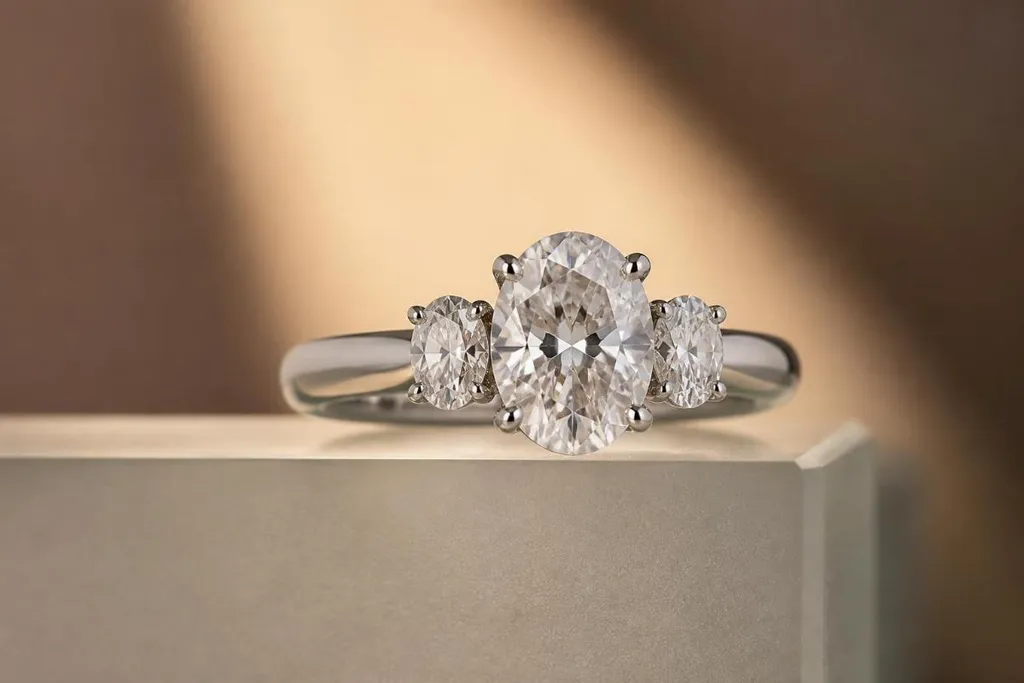
An engagement ring can be appreciated purely for its design, but a trilogy carries an additional layer of meaning. Three stones are traditionally associated with a couple’s past, present and future, turning the arrangement into a visual expression of continuity. With oval lab-grown diamonds and a 950 platinum setting, that symbolism is presented in a particularly refined form: graceful shapes, a naturally white metal and enough brilliance to create presence without relying on elaborate decoration.
For someone attracted to this combination, the option to order the platinum Louella ring from Lily Arkwright shows how three oval lab diamonds can create a balanced composition in platinum. Rather than treating the side stones as background decoration, the trilogy allows all three diamonds to contribute to the ring’s character while maintaining a clear central focus.
Why Three Stones Carry Lasting Meaning
The familiar past-present-future interpretation is one reason trilogy engagement rings remain so enduring. The centre stone can represent the present, framed by a shared history on one side and the future on the other.
That meaning does not have to be interpreted rigidly. Three diamonds might instead represent friendship, love and commitment, or simply three important chapters in a relationship. The symbolism is personal enough to evolve with the wearer.
From a design perspective, the arrangement also offers something a solitaire cannot: width across the finger. Instead of concentrating all visual impact in one centre diamond, a trilogy distributes brilliance laterally.
This can appeal to someone who wants a substantial-looking engagement ring but does not necessarily want that presence to come from one exceptionally large centre stone.
Why Oval Diamonds Suit a Trilogy Setting
Oval diamonds work particularly well in groups because their elongated outlines naturally create direction.
The centre oval establishes a graceful vertical line, while the side stones extend the composition across the finger. When their proportions are carefully coordinated, the three diamonds can appear connected without losing their individual outlines.
Scale is crucial. The centre diamond should normally remain visually dominant, with the side stones supporting rather than competing with it. Too little difference in size can make the arrangement feel more like a continuous row of equal stones; too much can leave the side diamonds looking disconnected.
This is where a larger centre stone may make sense for reasons beyond sheer size. A 2-carat oval, for example, can establish a strong hierarchy against smaller companion stones and make the three-stone structure immediately readable.
Someone who prefers a subtler composition may instead favour closer proportions, producing a softer transition from centre to sides.
The Role of 950 Platinum
Platinum brings visual restraint to a ring already rich in diamonds.
Its naturally white appearance sits quietly around colourless stones, allowing the three oval shapes and their brilliance to remain the principal features. Unlike yellow or rose gold, platinum does not introduce a strong contrasting colour into the composition.
This creates a clean, almost uninterrupted effect across the upper surface of the ring.
The metal’s density and durability are also valuable in a trilogy design. Three principal diamonds require several secure setting points, so the structure supporting them matters just as much as the visible aesthetics.
Platinum will still develop signs of everyday wear. Fine marks gradually create its characteristic patina, which many wearers accept as part of the metal’s natural evolution. Professional polishing can refresh the surface when a brighter finish is preferred.
Periodic inspection is particularly worthwhile on a trilogy ring because there are more claws and settings to monitor than on a straightforward solitaire.
Pairing a Platinum Trilogy with a Wedding Band
A three-stone engagement ring already occupies considerable visual space, so the accompanying wedding band benefits from careful consideration.
A plain platinum band offers a clean counterpoint, keeping the trilogy as the dominant feature. It can be particularly effective for someone who wants the symbolism and diamond arrangement of the engagement ring to remain clearly defined.
A diamond-set platinum wedding band creates a more brilliant bridal stack, but scale should remain controlled. Smaller stones can complement the oval trilogy without competing with it.
Setting profile also matters. Depending on how the side diamonds are positioned, a straight wedding band may sit closely beneath the engagement ring or leave a small gap. A shaped band can provide a closer contour where desired.
The best pairing is not necessarily the most elaborate one; it is the combination that allows each ring to retain its purpose.
Final Thought
A platinum oval trilogy brings together symbolism and proportion in a design that feels both meaningful and visually complete. Three lab-grown diamonds provide a natural narrative, while their elongated shapes create graceful coverage across the finger.
Set in 950 platinum, the composition remains cool, cohesive and focused on the stones themselves. For someone who wants an engagement ring to communicate more than brilliance alone, the trilogy offers an enduring way to represent a relationship as something with a history, a present and a future.